
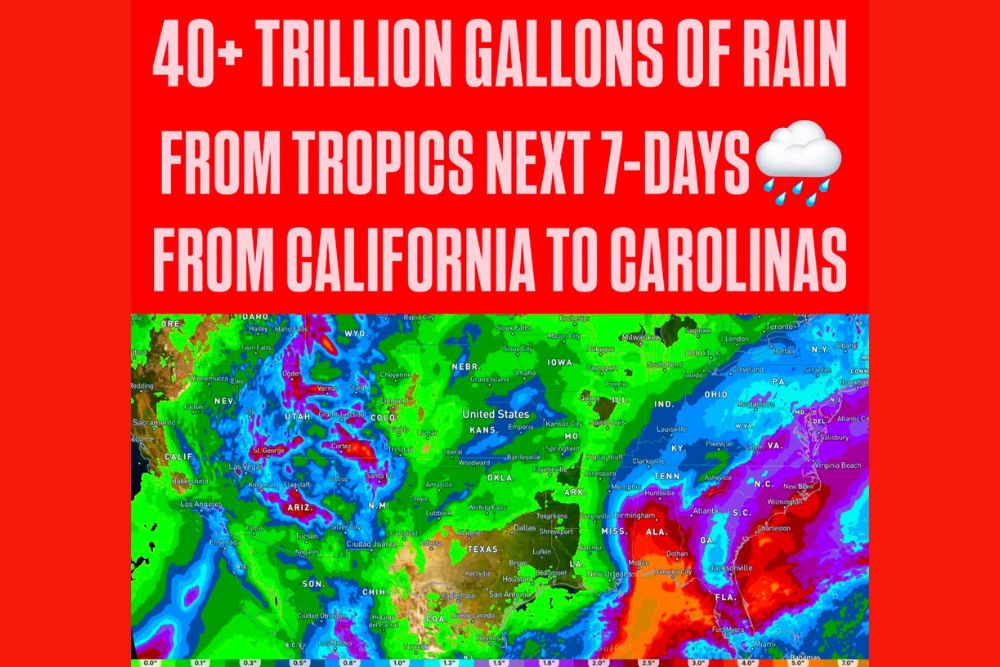
More Than 40 Trillion Gallons of Rain Could Fall From California to the Carolinas Over the Next 7 Days as Tropical Moisture Floods the Lower 48
United States – A massive amount of rain is headed for large parts of the country. Over the next seven days, more than 40 trillion gallons of rain are expected to fall across the lower 48 states, stretching from California to the Carolinas. The heavy rain is being fueled by three tropical systems sending moisture into the United States, including Isaias in the Gulf and Rachel in the eastern Pacific.
How Much Is 40 Trillion Gallons?
Forty trillion gallons is an enormous amount of water. To put it in perspective, it would be enough to fill tens of millions of Olympic-sized swimming pools. Spread across the country, this amount of rain could lead to flooding in some areas while bringing much-needed relief to others dealing with dry conditions.
Tropical Moisture From Three Directions
What makes this rain event unusual is that moisture is coming from multiple tropical systems at the same time. Isaias, which is strengthening in the Gulf, is expected to bring heavy rain to the Southeast. Meanwhile, moisture from Rachel and other activity in the eastern Pacific is being pulled north into the Southwest and Rockies.
When tropical moisture interacts with fronts and upper-level weather systems, it can produce very heavy rain over a wide area.
Heaviest Rain in the Southeast
Some of the heaviest rain in the country is expected across the Southeast, mainly from Isaias. Rainfall projections show 3 to 5 inches or more across parts of eastern Alabama, Georgia, and the Florida Panhandle, including areas near Dothan, Panama City, and Tallahassee.
Heavy rain is also expected across northern Florida, including Jacksonville, and along the Carolina coast, including areas near Charleston, Wilmington, and New Bern. Parts of southeastern Virginia, including Virginia Beach, could also see significant totals.
Rainfall will also spread across Mobile, Birmingham, Atlanta, and Huntsville, with many areas picking up 1 to 3 inches.
Soaking Rain for the Southwest and Rockies
Farther west, tropical moisture is expected to bring a soaking rain to parts of the Desert Southwest and Rockies. Heavy rain is projected across southern Utah, including areas near St. George, along with southwestern Colorado near Cortez and Grand Junction, and northern New Mexico near Santa Fe and Gallup.
Parts of Arizona, including areas near Flagstaff and Kingman, could also see significant rain. Higher elevations in these areas may see snow as colder air moves in later in the period.
Some rain is also expected in parts of California and Nevada, especially in the mountains, as a cooler system moves into the West.
Rain Across the Plains and Midwest
Moderate rain is also expected across parts of the Central Plains and Midwest, including Nebraska, Kansas, Iowa, Missouri, Illinois, and Indiana. Totals there are expected to be lighter, generally in the half inch to 1.5 inch range in many areas.
Texas Stays Mostly Dry
One notable exception is Texas. Much of the state, including Dallas, San Antonio, Houston, and West Texas, is expected to see little to no rain over the next week. The developing Gulf storm is helping to keep rain away from Texas by pulling moisture east and leaving drier air behind.
Flooding Concerns
With so much rain expected, flooding is a major concern in several regions. In the Southeast, heavy rain from Isaias could lead to flash flooding, rising rivers, and coastal flooding, especially near where the storm makes landfall.
In the Southwest, heavy rain over mountains, canyons, and burn scars can quickly cause flash floods and debris flows. Dry desert ground does not absorb water quickly, which means even moderate rain can lead to dangerous runoff.
Good News for Drought Areas
While flooding is a concern in some areas, the rain could also be beneficial for regions dealing with drought or dry conditions. Many parts of the Southeast and West have been dry recently, and a soaking rain could help refill reservoirs, improve soil moisture, and lower wildfire risk.
Stay Weather Aware
With multiple tropical systems involved and heavy rain spread across much of the country, residents should keep checking forecasts and alerts throughout the week. Anyone in flood-prone areas should be ready to move to higher ground, and drivers should never drive through flooded roads.
For more national weather updates and tropical coverage, stay with bchssreport.com.