
Northern Lights Pillars Dance Over Michigan’s Upper Peninsula as Aurora Shows Up on Cameras as Far South as Ludington and Gladwin
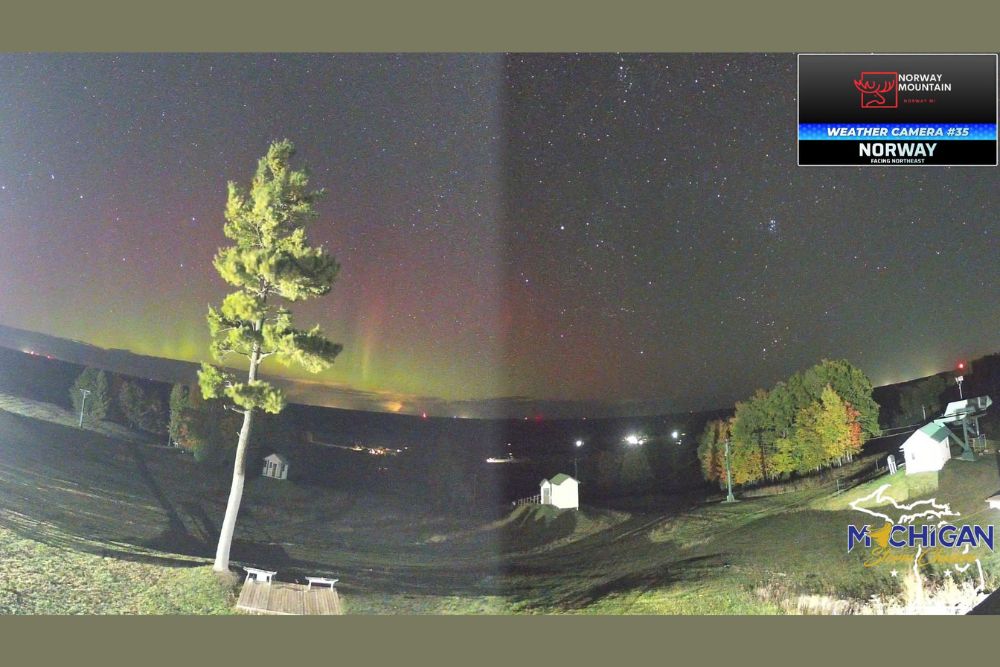
Norway, Michigan – The northern lights put on a show over Michigan late Sunday night, with glowing pillars of green and red light appearing in the northern sky. A weather camera in Norway, Michigan, located in the southern Upper Peninsula, captured the aurora around 11 p.m. EDT on Sunday, October 4, showing tall columns of color rising above the horizon. At that time, the northern lights could be seen on camera as far south as a line from Ludington to Gladwin in the Lower Peninsula.
Pillars of Light Over the Upper Peninsula
The camera view, facing northeast, showed bright vertical pillars of aurora glowing above the treeline. The lower part of the display shimmered in green, while red and pink hues stretched higher into the sky. Combined with a clear, star-filled sky and early fall colors on nearby trees, the scene made for a stunning nighttime view.
Aurora pillars, sometimes called rays, form when charged particles from the sun travel along Earth’s magnetic field lines and light up the upper atmosphere. These columns can appear to move, brighten, and fade within minutes.
How Far South Was the Aurora Visible?
At around 11 p.m., the aurora was detectable on cameras as far south as a line stretching from Ludington, along the Lake Michigan shoreline, east to Gladwin in central Michigan. That means people in parts of the northern Lower Peninsula had a chance to capture the lights with a camera or smartphone, even if they could not see them clearly with their eyes.
Naked-eye viewing was possible across the northern Upper Peninsula, where darker skies and a more northern location gave viewers the best chance to see the colors directly.
Camera vs. Naked Eye
Many people are surprised to learn that cameras can often pick up the northern lights better than the human eye. Modern smartphones and digital cameras can capture more light and color during long exposures, revealing greens and reds that may look faint, gray, or invisible to the naked eye.
If the aurora seems weak or hard to spot, pointing a phone camera north and using night mode or a long exposure setting can reveal a much more colorful display.
Tips for Seeing the Northern Lights
For the best chance to see the aurora, viewers should look north and find a location away from city lights. Open areas with a clear view of the northern horizon, such as lakeshores, fields, and hilltops, work best. The darker the sky, the better the chances of seeing the colors.
It also helps to give your eyes about 15 to 20 minutes to adjust to the dark. Avoid looking at bright phone screens during that time, since even brief light exposure can reduce night vision.
Why the Northern Lights Happen
The northern lights, also known as the aurora borealis, are caused by activity on the sun. When the sun releases bursts of energy, such as solar wind or coronal mass ejections, charged particles travel through space toward Earth. When those particles reach Earth’s magnetic field, they are guided toward the polar regions, where they collide with gases in the upper atmosphere.
Those collisions release energy in the form of light. Oxygen produces the common green glow at lower altitudes and red light higher up, while nitrogen can create blue and purple shades.
A Good Time of Year for Aurora Viewing
Fall is often a great season for northern lights viewing in Michigan. Nights are getting longer and darker, giving more hours to watch the sky. Periods around the fall equinox have also historically been associated with increased geomagnetic activity, which can boost aurora chances.
The sun is also in an active phase of its cycle, which has led to more frequent aurora displays across the northern United States over the past couple of years.
Clear Skies Helped the Show
Mostly clear skies over the Upper Peninsula helped make Sunday night’s display visible. Cool fall air and dry conditions often lead to crisp, clear nights, which are ideal for stargazing and aurora watching.
Keep Watching the Sky
Northern lights activity can change quickly, and more displays are possible in the coming nights and weeks. Residents across Michigan, especially in the Upper Peninsula and northern Lower Peninsula, should keep an eye on the sky on clear nights and have their cameras ready.
For more Michigan weather updates and sky watching news, stay with bchssreport.com.