
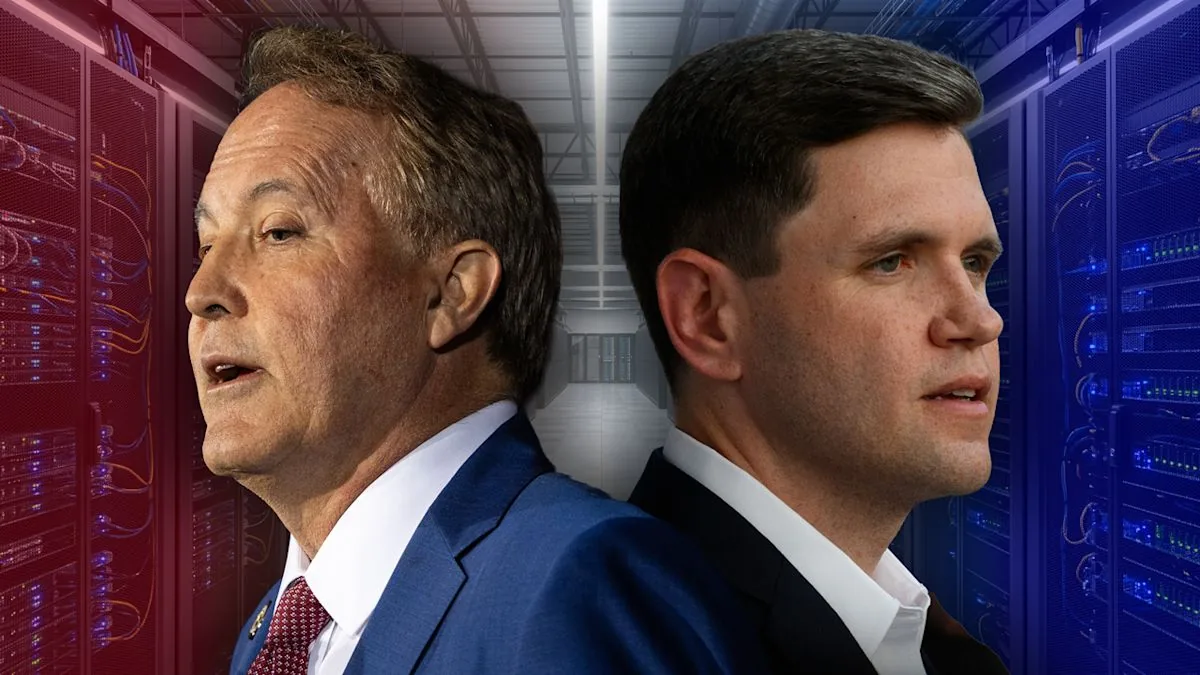
In Texas, Ken Paxton and James Talarico Offer Competing Plans to Regulate Data Center Growth, Taxes, Power Use and Local Control
AUSTIN, TX — Texas’ fast-growing data center industry has become a new flashpoint in the state’s U.S. Senate race, with Ken Paxton and James Talarico rolling out sharply different proposals for how to handle the boom. Both candidates say taxpayers and utility customers should not be left with the bill for new facilities, but they part ways on who should have the final say and what rules should apply.
The competing plans touch on electricity, water, housing, local communities and tax policy. Paxton is pressing for federal action on national security and child safety, while Talarico is focusing on local control, the end of corporate tax breaks and a public dividend tied to AI profits. For Texas voters, the debate reflects a larger question: how to balance economic growth with the strain on infrastructure.
Paxton’s plan links data center rules to power, water and national security
Paxton’s four-point “Texas First Data Center Plan” blends state-level concerns with federal action. His campaign says he would back a ban on Chinese technology in American data centers and related infrastructure, and he wants companies held criminally liable if their facilities power AI chatbots that undermine children’s safety.
He also says he would co-sponsor the DATA Act, which he argues would reduce outdated federal rules and encourage new power systems so data centers do not drive up Texans’ electric costs. On the state side, Paxton supports Gov. Greg Abbott’s ideas to limit construction in rural neighborhoods, require controls on noise and light, improve traffic planning and emergency coordination, and repeal sales tax exemptions.
Paxton’s plan would also require data centers to fund their own electricity infrastructure and add to Texas’ electric capacity instead of drawing more heavily from the existing grid. For cooling, he favors closed-loop water systems designed to reuse water.
Talarico pushes local control and a public share of AI profits
Talarico released his “Hold Data Centers Accountable Plan” in July, framing the issue around affordability and community voice. His proposal would repeal tax incentives for data centers and other large companies, give local residents more say over construction and require AI companies to pay for their own electricity and water infrastructure.
He also wants data centers held responsible for polluting water. One of the most distinctive parts of his plan is an “AI Dividend,” which would give every American a share of profits generated by American AI companies. Talarico has said the state should lead on innovation, but only if Texans also benefit from that growth.
In campaign remarks, he has argued that data centers are adding pressure to housing costs, small businesses and utility bills. That message is aimed at voters who are worried that the industry’s expansion is happening faster than communities can absorb.
Both candidates want the industry to pay its own way
Despite the differences, the two campaigns overlap on a key point: they both say the public should not subsidize the industry’s infrastructure needs. Each wants data centers to cover the electricity and water systems required to operate at scale rather than shifting those costs to customers.
That shared position gives the debate an unusual shape. The disagreement is not over whether the industry should shoulder more responsibility, but over how broad those responsibilities should be and which level of government should enforce them. In practice, that could mean very different outcomes for how quickly facilities are built and what they must provide before opening.
Both plans also reflect rising public concern about the pressure data centers place on the power grid. In a state where electricity demand is already a major issue, the question is no longer just how many centers Texas can attract, but how to make them fit without raising costs for everyone else.
Tax breaks have become a central political target
Tax incentives are one of the clearest areas of overlap between the two candidates. Both now support repealing tax breaks for data centers, though they reach that conclusion in different ways and with different broader goals.
Talarico has made the issue a key part of his criticism of Paxton, pointing to Paxton’s earlier vote as a state lawmaker for the sales tax exemption that helped encourage data center construction. Paxton’s campaign says his new plan would repeal sales tax exemptions and other outdated incentives.
That shift suggests the political ground has moved as the industry has expanded. What was once promoted as an economic development tool is now being reexamined by both campaigns as voters ask whether those incentives are still worth the tradeoffs.
The battle over local say, neighborhood impact and the power grid
The biggest philosophical divide may be over who gets to decide where data centers go. Talarico wants local residents to have more input when companies seek to build in their communities, arguing that neighborhood effects should matter as much as statewide growth targets.
Paxton, by contrast, supports limits on rural construction and wants companies to deal with issues like noise, lighting, traffic and emergency response. His proposal does not say whether local governments would get final approval power. That leaves open a major question about how much authority cities and counties would actually retain.
The rivalry also reflects broader concerns about the grid itself. Paxton says data centers should expand Texas’ power capacity, while Talarico says AI firms should pay for the electric systems they need so those costs are not passed on to consumers. The outcome could shape future utility bills, water use and the pace of development across the state.
What each campaign is aiming to tell Texas voters
Paxton is speaking to voters worried about China, artificial intelligence, child safety, rural development and the reliability of the Texas power grid. His plan also aligns him with Abbott’s administration, which has proposed its own limits on the industry’s growth.
Talarico is targeting people concerned about utility costs, corporate tax breaks, local control and the effect of data centers on housing and small businesses. He is casting the issue as one of fairness: if the industry is going to prosper, he argues, Texans should see benefits instead of only costs.
The candidates’ remarks came from campaign events in July and on Sept. 28, 2026, and their plans now place the data center boom squarely inside a broader debate over economic development, consumer costs and the role of government in a rapidly changing technology sector.