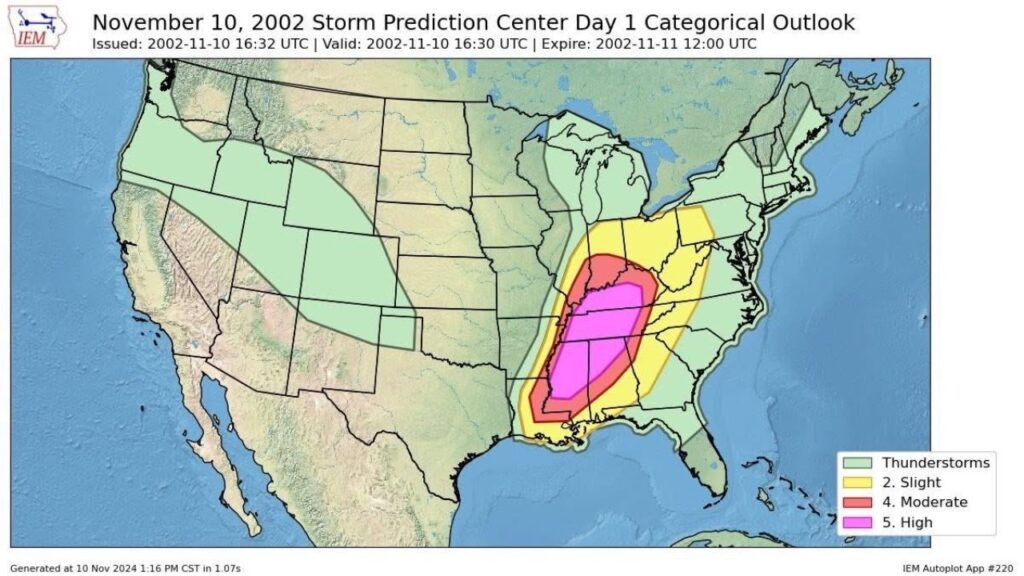
Tennessee, Kentucky and Mississippi Mark 24 Years Since the November 10, 2002 Tornado Outbreak, When the Only F4 Struck Outside the High Risk Zone
UNITED STATES — November 10 marks the anniversary of one of the most infamous fall severe weather outbreaks in modern U.S. history. On November 10, 2002, a powerful storm system triggered a widespread tornado outbreak across the Mississippi, Tennessee and Ohio Valleys.
Forecasters are revisiting the event with an “On This Day in Weather History” look back, and they are highlighting one surprising detail: the outbreak’s only F4 tornado struck in an area under just a Slight Risk.
The Storm Prediction Center’s Outlook That Day
| Detail | Information |
|---|---|
| Date | November 10, 2002 |
| Outlook issued | 16:32 UTC (10:32 a.m. CST) |
| Valid until | 12:00 UTC November 11, 2002 (6 a.m. CST) |
| Highest risk level | High Risk |
| Notable fact | The only F4 tornado occurred in a Slight Risk area |
High Risk Over the Mid-South
The Storm Prediction Center placed a rare High Risk, its top category, over a large part of the Mid-South, including:
- Western and Middle Tennessee
- Western Kentucky
- Northern and central Mississippi
- Northwest Alabama
High Risk days are uncommon and are only issued when forecasters expect a major tornado outbreak or widespread severe weather.
Moderate Risk Surrounded the High Risk Zone
A Moderate Risk wrapped around the high-risk area, covering parts of:
- Northern Louisiana
- Eastern Arkansas
- Southern Indiana
- Kentucky and Tennessee outside the high-risk core
- Alabama
Slight Risk Stretched Into the Ohio Valley
A broader Slight Risk extended farther north and east, reaching parts of:
- Indiana and Ohio
- West Virginia and western Pennsylvania
- Southern Michigan
- Georgia and the Gulf Coast
The Surprise: The Only F4 Was in a Slight Risk
Even with a High Risk over the Mid-South, the outbreak’s only F4 tornado, one of the strongest ratings on the old Fujita scale, happened in an area that had only been given a Slight Risk. Forecasters are asking followers to guess where it touched down, with the full story to come in an upcoming write-up.
Why This Matters for Today’s Forecasts
The 2002 outbreak shows that:
- Risk levels show overall chances, not exact locations
- Strong tornadoes can still form outside the highest-risk zones
- People in Slight or Marginal risk areas should take warnings seriously
Fall Tornado Outbreaks Are Not Rare
While spring gets most of the attention, November has a history of dangerous tornado outbreaks, especially across the Mid-South and Ohio Valley, when warm, humid air clashes with strong fall cold fronts.
A Timely Reminder in 2026
The anniversary comes as a cold front brings a Level 1 severe storm risk to the lower Ohio and western Tennessee Valleys on Wednesday, November 11, 2026, a reminder that fall severe weather remains a real threat.
Tornado Safety Tips
- Have multiple ways to receive warnings
- Know your safe place, such as a basement or interior room
- Don’t ignore warnings just because your area is in a lower risk category
- Stay alert at night, when tornadoes are harder to see
Stay with Bchssreport.com for the latest updates on this story.
About The Author
