
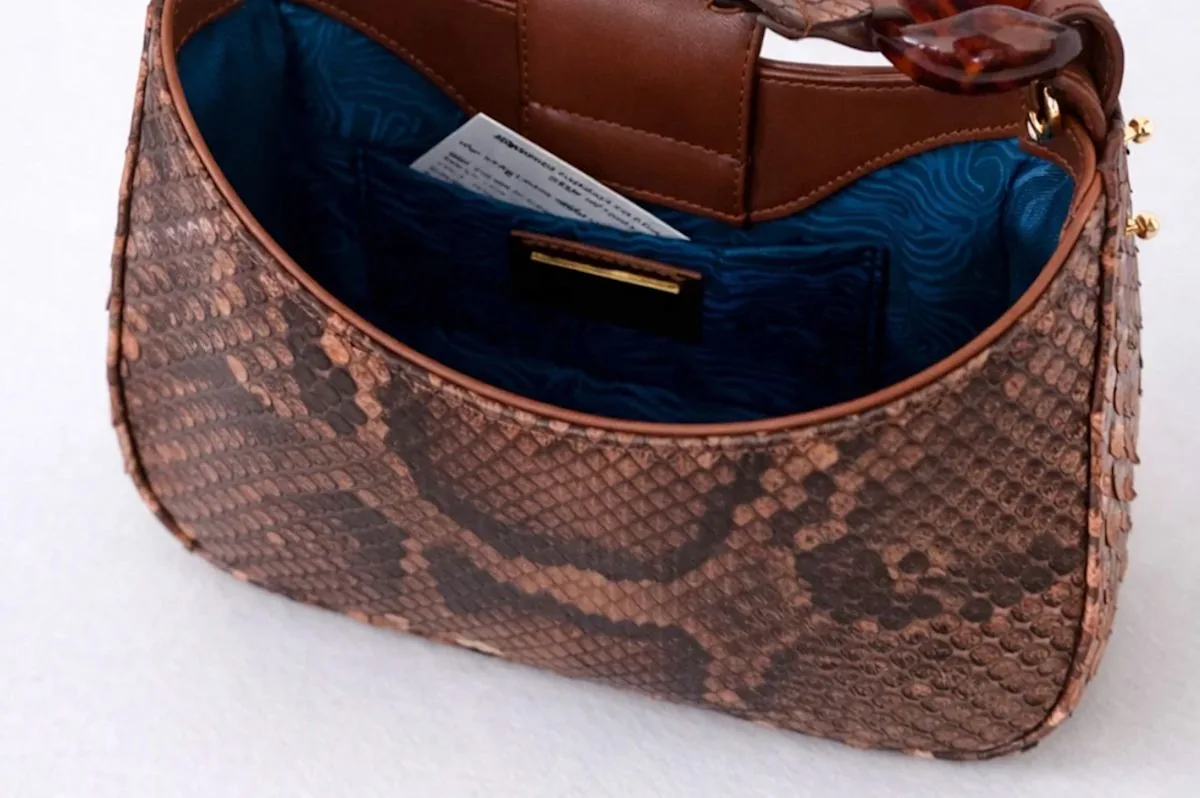
South Florida Entrepreneur Turns Invasive Everglades Burmese Python Skins Into Luxury Handbags With Women Leading the Hunt, Design and Production
MIAMI, FL — A South Florida business is giving new purpose to an invasive species that has damaged the Everglades for years. Women in the region are turning Burmese python skins into luxury handbags, pairing wildlife removal with small-business creativity.
The work connects python hunters, designers and manufacturers in a partnership built around the snakes that are pulled from the wetlands. One of the hunters involved, Amy Siewe, spends nights in the Everglades searching for the animals and has caught about 800 pythons in roughly eight years, according to WSVN.
For the company behind the bags, the appeal is both practical and symbolic: use what would otherwise be discarded and turn it into something high-end. The result is a product that links conservation, fashion and local entrepreneurship in one unusual business model.
How the python problem became part of Florida life
The Burmese python is not native to Florida, and its presence has become one of the state’s best-known invasive-species problems. There is disagreement over how the snakes first took hold in the region. Some people say the animals were released pets, while others point to Hurricane Andrew in 1992, when a breeding facility was struck and snakes may have escaped into the swamps.
Whatever the exact path, the impact has been serious. Siewe told WSVN that pythons are eating 98% of the mammals in parts of the Everglades, and that the population is not slowing down. Their spread has disrupted food webs and entire ecosystems, making the species a major concern for wildlife managers and hunters alike.
The scale of the problem helps explain why people are looking for new ways to deal with the snakes. In this case, the answer has been to make use of the skins after the animals are removed from the environment.
What python hunters must do before the skins can be used
Florida added Burmese pythons to its prohibited species list in 2021, reflecting the threat they pose to native wildlife. At the same time, the snakes are protected by anti-cruelty laws. That means hunters must kill them humanely on private property and only with landowner permission.
Those rules shape the work of people like Siewe, who spends her nights looking for the snakes in the Everglades. The process is not casual or recreational; it is part of a larger effort to control an invasive animal that has become deeply established in the region.
Because the pythons cannot simply be left in place, the skins become a usable material once the snakes are removed. That creates the opening for the handbag business, which depends on careful handling from the field all the way to finished product.
GG Maull turns an invasive species into a luxury item
The handbag company involved in the project is GG Maull, owned by Gretchen Maull Berger. Berger is using the python skins to create luxury bags, bringing the material into a fashion market that prizes rarity and craftsmanship.
Berger said the idea began with a simple question: why not take something being discarded and make it beautiful? That approach frames the handbags as a way to create value from an environmental nuisance while also giving the material a second life.
The company’s work is not only about the finished product. It is also about the people behind it, from the hunters who remove the snakes to the makers who turn the skins into bags. Berger said the project is meant to support women working across those steps, including hunting, design and manufacturing.
Women are centered in the hunting, design and manufacturing
Berger said she wanted women at the center of the business, and that goal runs through the project from start to finish. The python skins come from women hunters, the design work is shaped by women, and the manufacturing side is also part of that same network.
Siewe, who has built her reputation as the “Python Huntress,” represents one side of that effort. Berger has said she appreciates being able to support women who are out in the field removing the snakes and helping address the invasive-species problem.
The partnership creates a rare blend of conservation work and small-business branding. It also gives the hunters a visible role in a product that is meant to be both practical and luxurious, rather than purely utilitarian.
A business idea tied to wildlife removal and ecosystem repair
For Siewe, the point of the work is straightforward: the snakes are here, they are damaging the environment, and they need to be removed. She told WSVN that the animals are not at fault for being in Florida, but they still have to go because there is no other choice.
That perspective reflects the larger battle in the Everglades, where introduced species can outcompete native animals for food, water, sunlight and space. In many cases, human activity has moved plants and animals into places where they were never supposed to be, and the results can be lasting.
The handbag project does not solve the python problem on its own, but it does show one way small businesses can respond to environmental challenges. In South Florida, that has meant turning an invasive snake into a product that is as much a statement as it is an accessory.