19 States Have Voted to Lock the Clock on Permanent Daylight Saving Time, but Americans Will Still Fall Back This Sunday Because Congress Hasn’t Acted
UNITED STATES — Most Americans will turn their clocks back one hour this Sunday, November 1, as daylight saving time ends. But a growing number of states are ready to stop the twice-a-year switch for good.
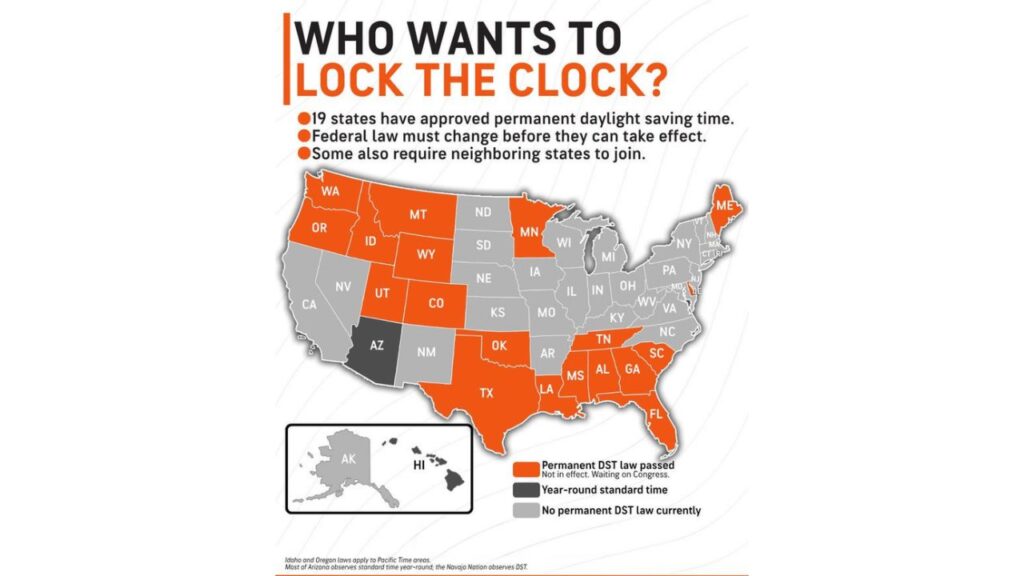
So far, 19 states have passed laws to make daylight saving time permanent. There is one big problem: none of those laws can take effect until federal law changes first.
The 19 States That Want Permanent Daylight Saving Time
These states have approved permanent daylight saving time, but the laws are not in effect and are waiting on Congress:
| Region | States |
|---|---|
| West | Washington, Oregon, Idaho, Montana, Wyoming, Utah, Colorado |
| Midwest | Minnesota |
| South | Texas, Oklahoma, Louisiana, Mississippi, Alabama, Tennessee, Georgia, South Carolina, Florida |
| Northeast and Mid-Atlantic | Maine, Delaware |
Why These Laws Have Not Taken Effect Yet
Under current federal rules, states can choose to stay on standard time all year, but they cannot move to permanent daylight saving time on their own.
That means the 19 states that passed laws are stuck until Congress changes federal law to allow it.
Some States Also Need Their Neighbors to Join
Even if federal law changes, some state laws come with another condition. Certain states will only switch if neighboring states agree to do the same, to avoid confusing time differences across state lines.
Idaho and Oregon Laws Apply Only to Pacific Time Areas
The laws in Idaho and Oregon apply only to parts of those states that are in the Pacific Time Zone. Areas in other time zones would not be affected by those changes.
Arizona and Hawaii Already Skip the Time Change
Two states already avoid changing clocks by staying on standard time year-round:
- Hawaii
- Most of Arizona
One exception in Arizona: the Navajo Nation does observe daylight saving time, so clocks there do change.
States With No Permanent Daylight Saving Time Law
Many states still have no permanent daylight saving time law. These include large states such as:
- California
- New York
- Illinois
- Pennsylvania
- Ohio
- Michigan
- North Carolina
- Virginia
Others without a permanent law include Alaska, Nevada, New Mexico, the Dakotas, Nebraska, Kansas, Iowa, Missouri, Arkansas, Wisconsin, Indiana, Kentucky, West Virginia, Maryland, New Jersey and most of New England.
The South and Mountain West Lead the Push
Looking at the map, support for permanent daylight saving time is strongest in two regions:
- The Mountain West and Pacific Northwest, from Washington to Colorado
- The South, stretching from Texas to Florida and up through Tennessee and South Carolina
What Happens This Sunday
For now, nothing changes. At 2 a.m. local time on Sunday, November 1, clocks in most of the country will fall back one hour to standard time, giving people an extra hour of sleep but bringing earlier sunsets.
The Debate Over Ending the Clock Switch
The push to “lock the clock” has been gaining momentum for years. Supporters of permanent daylight saving time point to more evening daylight, while others argue that permanent standard time is a better fit for morning light and daily routines.
Until Congress acts, most Americans will keep changing their clocks twice a year.
Quick Tips for the Time Change
- Set clocks back one hour before bed Saturday night
- Check smoke and carbon monoxide detector batteries
- Adjust sleep schedules gradually to ease the switch
Stay with Bchssreport.com for the latest updates on this story.
About The Author
