
Rare Kelvin-Helmholtz Clouds Light Up the Sunset Sky Over Centennial, Colorado, Creating a Stunning Wave-Like Display
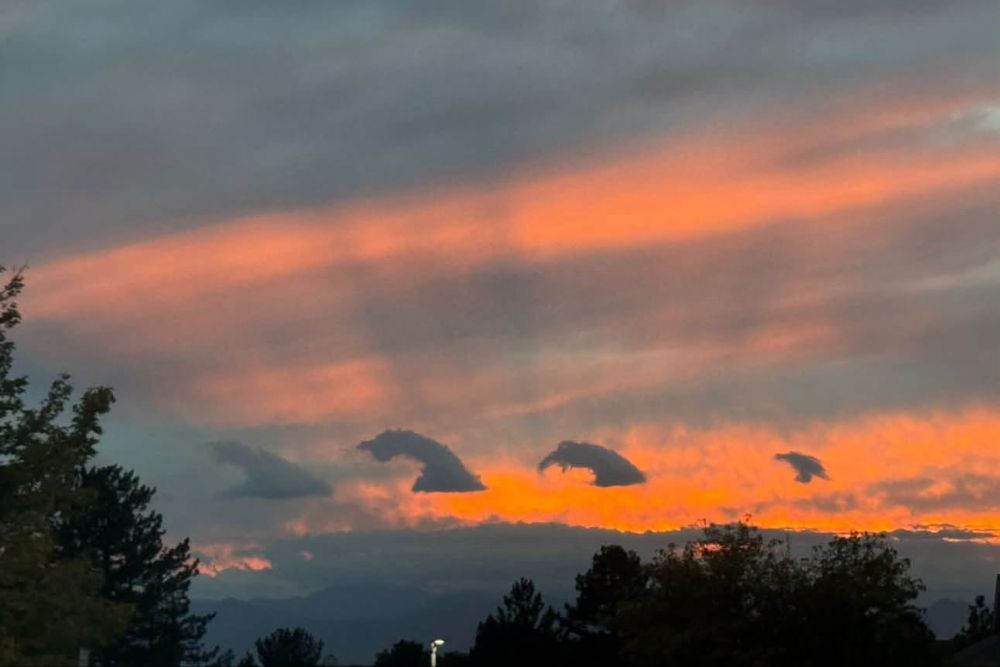
Centennial, Colorado – Residents in Centennial were treated to a truly rare and beautiful sight in the evening sky as Kelvin-Helmholtz clouds appeared against a glowing orange and pink sunset. The unusual cloud formations, which look like a row of curling ocean waves, stretched across the sky above the Front Range, leaving many people stopping in their tracks to grab their phones and capture the moment.
A Sky Full of Breaking Waves
The display featured several distinct cloud shapes lined up in a row, each one curling over at the top like a wave about to crash on the beach. Set against bright streaks of orange from the setting sun and darker gray clouds above, the scene looked almost like a painting. The dark silhouettes of the curling clouds stood out clearly against the glowing horizon, with the outline of the Rocky Mountains visible in the distance.
A local resident captured a photo of the striking formation, and it quickly drew attention from people amazed by how perfectly the clouds resembled rolling waves in the sky.
What Are Kelvin-Helmholtz Clouds?
Kelvin-Helmholtz clouds are some of the rarest and most visually striking cloud formations in the world. They form when two parallel layers of air move at different speeds or in opposite directions. The faster-moving upper layer of air drags across the top of the slower layer below, causing the boundary between them to roll and curl.
When there is enough moisture at that boundary for clouds to form, the rolling motion becomes visible, creating the distinctive wave-like shapes. The same physical process can be seen in other places in nature, such as when wind blows across the surface of water and creates waves.
The clouds are named after two scientists, Lord Kelvin and Hermann von Helmholtz, who studied the physics of this type of instability in fluids during the 1800s.
Why They Are So Rare
Kelvin-Helmholtz clouds are rare because the conditions needed to form them have to be just right. There needs to be strong wind shear, meaning a big difference in wind speed or direction between two layers of air. There also needs to be enough moisture at the right height for clouds to form along the boundary. On top of that, the upper layer of air usually needs to be warmer and lighter than the layer below, allowing the waves to develop without immediately mixing together.
Even when they do form, Kelvin-Helmholtz clouds often only last a few minutes before the waves break apart and disappear. That short lifespan makes spotting them, let alone photographing them, a special experience.
Why Colorado Is a Good Place to See Them
The Front Range of Colorado can be one of the better places in the country to spot unusual cloud formations. Winds moving over and around the Rocky Mountains often create different layers of air moving at different speeds, especially as weather systems approach or pass through the region. These complex wind patterns can lead to striking sky displays, including lenticular clouds, wave clouds, and occasionally Kelvin-Helmholtz clouds.
With a storm system and tropical moisture moving through the region this week, the atmosphere over Colorado has been especially active, which may have helped set the stage for this rare sight.
A Sign of Turbulence in the Sky
While Kelvin-Helmholtz clouds are beautiful to look at from the ground, they are also a sign of turbulence higher up in the atmosphere. The same rolling motion that creates the wave shapes can cause bumpy conditions for aircraft flying through that layer of air. Pilots often watch for these formations because they signal strong wind shear.
Tips for Spotting Unusual Clouds
Anyone hoping to see rare clouds like these should keep an eye on the sky during sunrise and sunset, when the lighting makes cloud shapes easier to see and photograph. Windy days, especially when weather systems are moving through, can also increase the chances of spotting unusual formations. Having a phone or camera ready is key, since these clouds can disappear within minutes.
A Moment Worth Remembering
For those lucky enough to look up at the right time, the Kelvin-Helmholtz clouds over Centennial were a reminder of how amazing the sky can be. Moments like this show the hidden forces at work in the atmosphere, turning invisible winds into a breathtaking display.
For more Colorado weather updates and stunning sky stories, stay with bchssreport.com.