Illinois, New York, Massachusetts and Colorado Face Snowfall Ranges Up to 670 Inches in 2026-27 Winter Forecast as Super El Niño Approaches
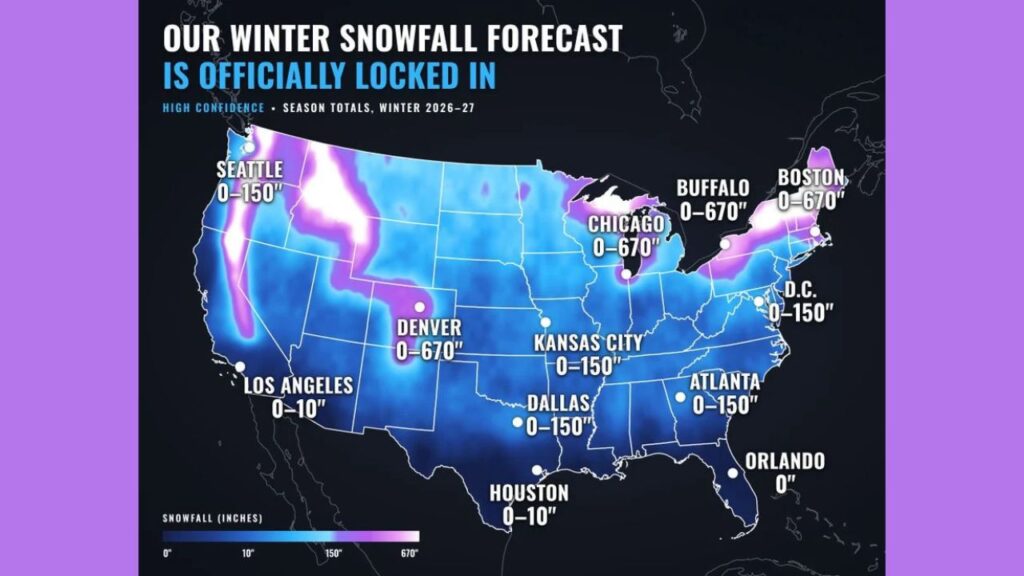
CHICAGO, ILLINOIS — A newly released 2026-2027 winter snowfall forecast places Chicago, Buffalo, Boston and Denver in the highest snowfall range on the map, with season totals forecast between 0 and 670 inches, as a Super El Niño develops ahead of winter.
The outlook covers the entire Lower 48 and assigns each major city a season-long snowfall range, from the snowy Great Lakes to the warm Gulf Coast.
Winter Snowfall Outlook: Season Totals Labeled High Confidence
The forecast covers total seasonal snowfall for Winter 2026-27 and is labeled “high confidence” and “officially locked in.”
The map uses a color scale running from 0 inches in the darkest blue shades to 670 inches in the brightest white and purple shades, with 10 inches and 150 inches marked as key steps along the way.
Cities in the 0 to 670-Inch Range: Chicago, Buffalo, Boston and Denver
Four major cities sit in the highest tier on the map:
| City | State | Forecast Range |
|---|---|---|
| Chicago | Illinois | 0 to 670 inches |
| Buffalo | New York | 0 to 670 inches |
| Boston | Massachusetts | 0 to 670 inches |
| Denver | Colorado | 0 to 670 inches |
Chicago and Buffalo sit near the Great Lakes, where lake-effect bands can quickly add up. Boston falls within the New England snow zone, while Denver lies along the Front Range of the Colorado Rockies.
Cities in the 0 to 150-Inch Range: Seattle Through Atlanta
A second tier covers cities stretching from the Pacific Northwest to the Southeast:
| City | State | Forecast Range |
|---|---|---|
| Seattle | Washington | 0 to 150 inches |
| Washington | D.C. | 0 to 150 inches |
| Kansas City | Missouri | 0 to 150 inches |
| Dallas | Texas | 0 to 150 inches |
| Atlanta | Georgia | 0 to 150 inches |
Lowest Snowfall Ranges: Los Angeles, Houston and Orlando
The smallest totals on the map are reserved for the warmest cities:
- Los Angeles, California: 0 to 10 inches
- Houston, Texas: 0 to 10 inches
- Orlando, Florida: 0 inches
Orlando is the only city on the map given a single fixed number rather than a range.
Heaviest Snow Zones: Washington, Oregon, California, Colorado and the Great Lakes
The brightest shading on the map highlights the highest snowfall potential across:
- The Cascades of Washington and Oregon
- The Sierra Nevada in California
- The Rockies of Idaho, Montana, Wyoming and Colorado
- Great Lakes snow belts in Michigan, Illinois and New York
- Northern New England, including Massachusetts and Maine
These are mountain and lake-effect regions that typically see the most snow in the country during winter.
Lightest Snow Zones: Texas, Louisiana, Mississippi, Alabama, Georgia and Florida
The darkest blue shading covers the Gulf Coast and Southeast, including Texas, Louisiana, Mississippi, Alabama, Georgia and Florida. Of these, Florida stands out as the only area with a forecast of 0 inches.
Forecast Uncertainty: Ranges Cover Nearly Every Possible Outcome
The ranges on this map are extremely wide. A forecast of 0 to 670 inches covers everything from a completely snowless winter to more than 55 feet of snow, far beyond what any of these cities normally sees.
Even the 0 to 150-inch range spans from no snow at all to more than 12 feet. Seasonal totals depend on individual storm tracks, temperature swings and lake-effect events that cannot be pinned down months in advance.
Super El Niño Expected to Shape the 2026-27 Winter Pattern
The forecast arrives as a Super El Niño builds in the Pacific Ocean. A strong El Niño can shift the jet stream and change where winter storms track across the United States, which is why forecasters watch it closely heading into the season.
Winter Preparation: Steps for Snow-Prone States
Residents in Illinois, New York, Massachusetts, Colorado and other snow-prone states can get ready by:
- Checking snow removal equipment before the first storm
- Preparing vehicles with winter tires and emergency kits
- Stocking basic supplies in case of heavy snow days
Winter Outlook: Monitor Monthly Forecasts Through the Season
Residents across the country should follow monthly outlooks and local forecasts as winter approaches for a clearer picture of how much snow their area may actually receive.
Stay with Bchssreport.com for the latest updates on this story.
About The Author
